Beyond the 1RM: What Should You Track to Measure Strength Progress?
There is something uniquely satisfying about putting more weight on the bar than you have ever lifted before.
For many lifters, those numbers become landmarks. Your first 135-pound bench press. Two plates. 250. 275. Then perhaps the long pursuit of 300. Squat and deadlift numbers develop the same significance. They give us something concrete to chase and, when we finally get there, something worth remembering.
That is one reason the one-rep max, or 1RM, has remained such an important measure in strength training. It answers one of the simplest questions we can ask:
How much can I lift?
It is a great question.
It just isn't the only one.
As you spend more time under the bar, measuring strength becomes more interesting. You may want to know whether your bench press is progressing even when you haven't attempted a new maximum. You may want to compare your current strength with where you were six months ago. If you train the squat, bench press, and deadlift, you may care about your combined total. You may even want to know how your strength compares relative to your bodyweight.
A single number cannot tell that entire story.
Your Max Is a Moment. Your Progress Is the Story.
A new 1RM is an obvious sign of progress.
If you benched 275 pounds last year and bench 300 today, there isn't much mystery about whether you became stronger.
Training rarely moves in such convenient snapshots, though.
Between those two lifts might be months of workouts in which you never attempted a true maximum. Perhaps you added repetitions at 225. Maybe weights that once required a tremendous effort began moving cleanly. Your estimated 1RM increased. Your working weights climbed. You accumulated more productive training along the way.
Those workouts are where the strength was actually built.
That is why good strength tracking should preserve more than the occasional personal record. Your workout history gives those records context.
Instead of remembering that you once benched 275, you can see the training that eventually made 285 possible and what happened between 285 and 300.
That becomes particularly valuable when progress slows.
A lifter who looks only at personal records can easily conclude that nothing is happening because the number at the top hasn't changed. A longer view may show something very different.
Your max records what you accomplished.
Your training history shows how you got there.
The Big Three Give Us Another Measurement
For lifters who train the squat, bench press, and deadlift, there is another beautifully simple number:
The powerlifting total.
Add the best squat, bench press, and deadlift together and you have a broader measure of strength across the three primary powerlifting movements.
A 400-pound squat, 300-pound bench press, and 500-pound deadlift produce a 1,200-pound total.
That matters because individual lifts do not always progress together.
Your bench might remain unchanged while your squat climbs. Your deadlift may take off while your bench requires more attention. Looking only at one lift can make a productive training period appear stagnant.
The total changes the question from:
"Did my bench go up?"
to
"Am I becoming a stronger lifter?"
Both questions matter. They simply measure different things.
Then Bodyweight Changes the Conversation
Absolute strength is easy to understand.
If one lifter deadlifts 500 pounds and another deadlifts 400, the first lifter moved more weight.
But what if the first lifter weighs 250 pounds and the second weighs 160?
Now the comparison becomes more interesting.
Powerlifting has developed scoring systems specifically to help compare strength performances across different bodyweights. DOTS and Wilks are two names lifters are likely to encounter when they begin looking beyond raw totals.
You don't need a scoring formula to appreciate a big lift, and most people training for strength will never enter a powerlifting meet. But relative-strength scores provide another useful perspective on performance.
A lifter can therefore look at strength several ways:
What can I lift?
What is my powerlifting total?
How strong am I relative to my bodyweight?
How have those numbers changed over time?
Now we are measuring something much more interesting than a single PR.
This Was the Idea Behind eFitLog's Power-Lift Station
When we built the Power-Lift Station in eFitLog, the goal wasn't to create another place where someone could type a number into a calculator.
There are already plenty of calculators on the Internet.
The more interesting opportunity was bringing powerlifting and strength analytics closer to the workout history producing those numbers in the first place.
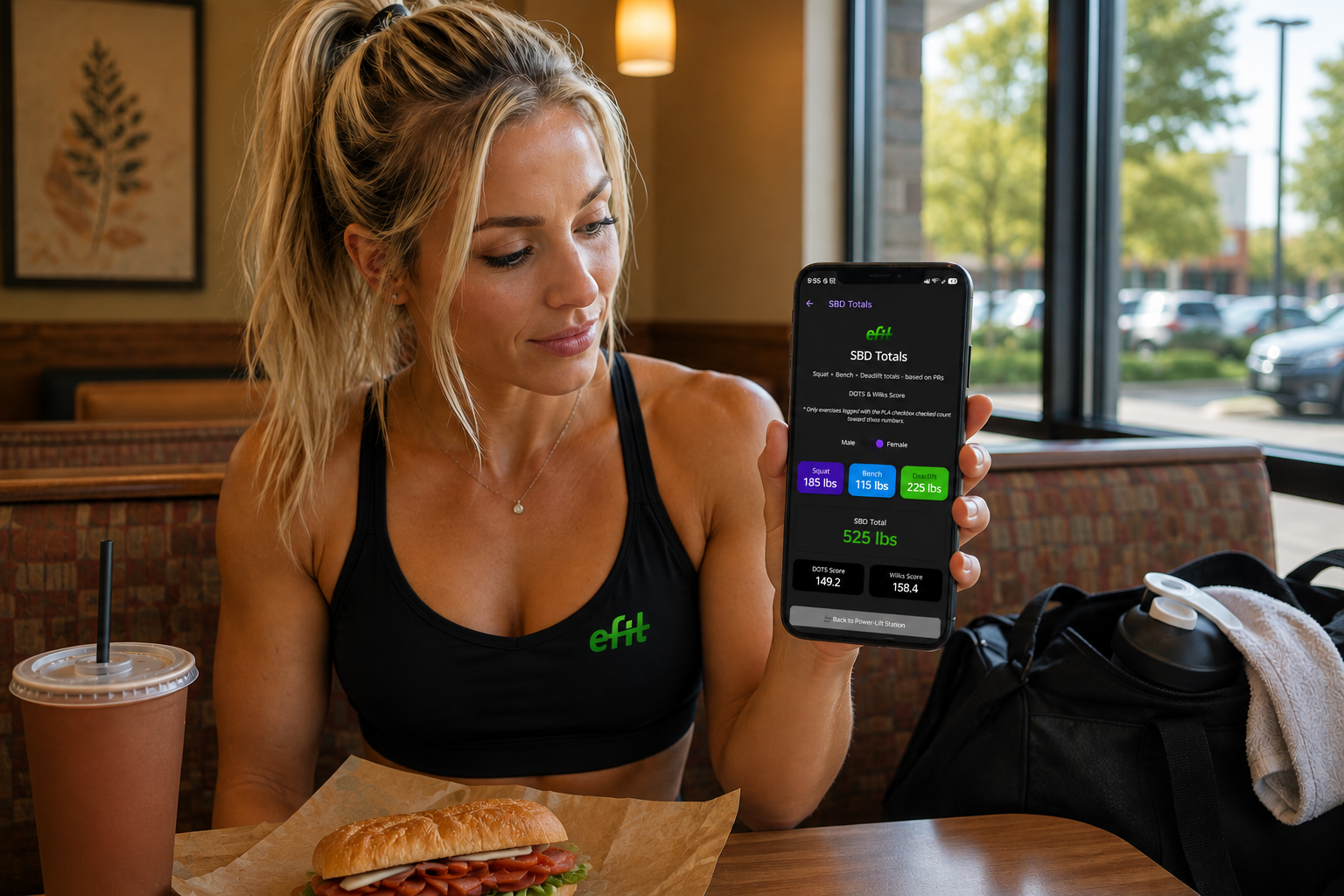
The eFitLog Power-Lift Station gives lifters a dedicated place to work with their squat, bench press, and deadlift performance, including 1RM analysis, powerlifting totals, DOTS and Wilks strength scoring, personal records, and strength progression.
A one-rep-max calculation can tell you something about a lift.
Your training history can tell you how you got there. Your personal records preserve the milestones. Your powerlifting total expands the view across the big three. Relative-strength scoring provides another way to understand the performance.
Put those pieces together and the question becomes much bigger than:
"What is my 1RM?"
It becomes:
"What is happening to my strength?"
That is the question we wanted the Power-Lift Station to help answer.
eFitLog's Power-Lift Station brings squat, bench press, and deadlift performance together with 1RM analysis, powerlifting totals, personal records, strength progression, DOTS, and Wilks scoring.
Explore the eFitLog Power-Lift Station →
You Don't Have to Be a Competitive Powerlifter
There is a tendency to hear terms like DOTS, Wilks, and powerlifting total and assume these tools belong only to people preparing for a sanctioned meet.
They don't.
You can care about your bench press without ever wearing a singlet.
You can chase a bigger squat because getting stronger matters to you. You can track your big three because those are the lifts around which you organize your training. And you can use powerlifting analytics simply because you enjoy understanding your own performance.
The tools may come from the world of powerlifting, but the information can be useful to anyone serious about getting stronger.
That is why the Power-Lift Station is built into a broader strength training platform rather than treated as something reserved for competitive athletes.
Know the Number. Then Keep the Story.
There will always be something special about a new maximum.
You load the bar. You know what the number means. You unrack it. And for a few seconds, months of training come down to whether that weight goes back up.
If it does, record it.
Celebrate it.
Then keep training.
Because the most useful strength record isn't just the number you eventually reached.
It is the history of how you got there and the evidence that you're still moving forward.
That is what strength progress looks like beyond the 1RM.
Learn what a 1RM measures, how estimated 1RM works, why lifters track it, and how it can help guide strength training.
Should You Care About Your One-Rep Max (1RM)?
Go Beyond Today's Number.
eFitLog was built to give your training history somewhere to go. Log your workouts, follow your lift history and strength trends, preserve your personal records, and see how your performance changes over time.
If the big three are part of your training, the eFitLog Power-Lift Station brings squat, bench press, deadlift, powerlifting totals, and strength analysis together in one place.
You can also use the free eFitLog 1RM Calculator to estimate your one-rep max from a set you've already completed.
Train. Plan. Progress. Connect. Own.
Find the confidence to begin.
Let us help you build the confidence to succeed.