Should You Care About Your One-Rep Max (1RM)?
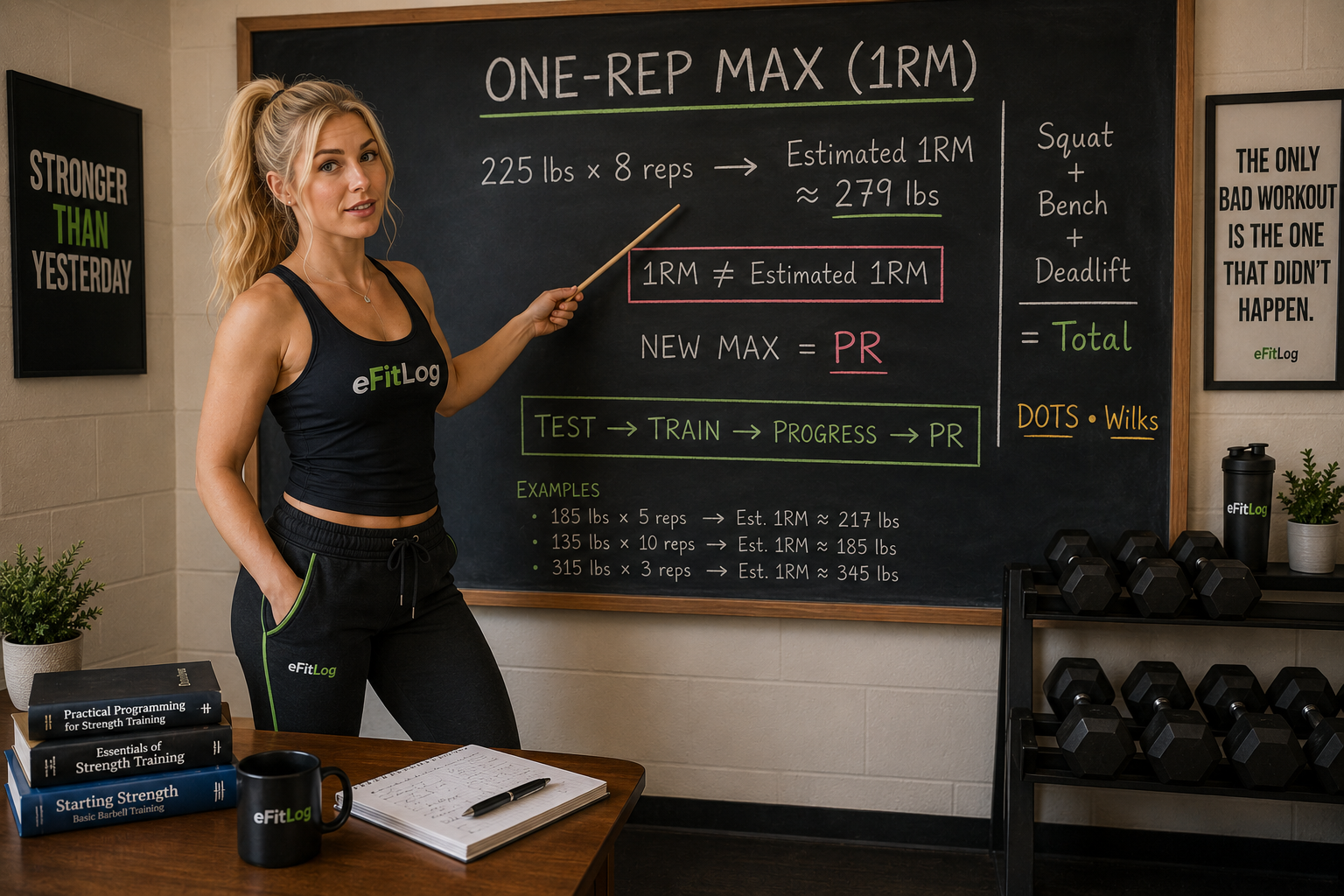
For all the science, formulas, percentages, and training programs built around the one-rep max, I have always thought of it in much simpler terms.
It is a measurement of strength. It is also a feat.
Your one-rep max, commonly called your 1RM, is the greatest amount of weight you have successfully lifted for one repetition of a particular exercise.
If your best bench press was 225 pounds and you eventually press 250, you have a new measurement of your strength and an accomplishment that did not exist before.
But that still leaves a more interesting question.
Why should you care?
For me, the answer was motivation. I wanted to get stronger. Increasing my 1RM gave that goal a number, and once there was a number, there was something to chase.
From "Get Stronger" to a Goal You Can See
"I want to get stronger" is a perfectly reasonable goal, but it doesn't tell you where the finish line is.
How much stronger? Stronger at what? How will you know when you get there?
A 1RM can change that.
Maybe you want to bench press 225 pounds for the first time. Maybe you're chasing 275, 300, or 315. Maybe the number that matters to you is on your squat, deadlift, overhead press, or another lift entirely.
The number is personal.
What matters is that it turns a general desire to become stronger into a specific accomplishment you can pursue.
Now today's workout has a relationship to something you want to accomplish. The sets, repetitions, weight, rest, supporting exercises, and workouts between where you are and where you want to be become part of getting there.
A strength goal gives the work a destination.
Reach one number and another begins to look possible. Something that once seemed out of reach can eventually become the weight you're preparing to attempt.
Your 1RM Gives Strength a Scoreboard
A one-rep max isn't the only way to measure strength progress.
If you used to bench 225 pounds for five repetitions and can now perform it for eight, you improved. If you can use more weight for the same quality repetitions, you improved. If a difficult working weight has become noticeably easier, something changed.
Your 1RM gives those other measurements a simple companion:
What is the most weight I have successfully lifted once?
If the answer used to be 225 pounds and it is now 250, the scoreboard changed.
There is also a better comparison available than worrying about what somebody else in the gym can lift: What could I do before, and what can I do now?
That is your progress.
Is a One-Rep Max the Same as a Personal Record (PR)?
When lifters talk about hitting a new personal record, or PR, they are often talking about exactly this: lifting more weight for one repetition than they ever have before.
In that case, the new lift is both a 1RM and a PR.
But a personal record can describe other best performances too.
Suppose the most you have ever bench pressed is 285 pounds. You successfully bench 290 for one repetition. That's a new one-rep max and a new personal record.
But suppose your best set with 225 pounds was eight repetitions and today you complete ten. That's a PR too, even though you didn't attempt a one-rep max.
A new 1RM can be a PR.
But not every PR has to be a 1RM.
That distinction matters because progress doesn't only happen when you put a new maximum weight on the bar.
More weight, more repetitions with the same weight, and new best performances across different rep ranges can all tell you something about how your strength is changing.
That gives you more opportunities to recognize progress instead of waiting for your next all-out maximum attempt.
Your Calculated 1RM Is Actually an Estimated 1RM
This is another distinction worth understanding.
If you bench press 225 pounds for eight repetitions, we know one thing for certain: you successfully benched 225 pounds for eight repetitions.
Put that performance into a 1RM calculator and a formula can use the weight and repetitions you completed to estimate the maximum weight you may currently be capable of lifting for one repetition.
That result is an estimated one-rep max, often called an estimated 1RM or e1RM.
Your demonstrated 1RM records something you have actually accomplished. Your estimated 1RM uses something you have accomplished to estimate your current one-repetition strength.
And there is an important consequence.
If a calculator estimates your bench press 1RM at 292 pounds, you do not suddenly have a 292-pound personal record.
You have an estimated 1RM of 292 pounds. The PR comes when you actually perform the lift.
Enter a weight and rep set you've already completed and get an estimated 1RM with the free eFitLog calculator.
Try the Free eFitLog 1RM Calculator →
Why Estimate Your 1RM Instead of Just Testing It?
You don't need to attempt a maximum every time you want evidence that you're getting stronger.
Suppose you bench 225 pounds for five repetitions. After more training, you get six. Later, you get eight.
You haven't tested another one-rep max, but you clearly haven't been standing still.
An estimated 1RM gives you a common reference for comparing those performances. Instead of waiting until your next maximum attempt to see whether anything changed, your completed working sets can provide another view of your strength progress.
That becomes particularly useful over time.
One estimated 1RM is a number.
A history of improving performances begins to show a trend.
You don't always have to test progress to see progress.
So What Problem Does a 1RM Calculator Actually Solve?
There are plenty of one-rep max calculators on the Internet. The equation itself isn't the interesting part.
The useful question is what the calculation tells you about your training.
The free eFitLog 1RM Calculator starts with a set you have already completed. Enter the weight you lifted and the repetitions you performed, and the calculator gives you an estimated one-rep max.
No account. No signup. Get the number and use it.
But the number becomes more useful when you can put it into context.
Is your estimated 1RM higher than it was several months ago? Are you performing more repetitions with the same weight? Are your working weights increasing? Has progress stalled?
What happened in the training between then and now?
The calculator gives you an estimate. Your training history gives that estimate context.
eFitLog's free web tools are available without an account or signup.
Explore eFitLog Free Training Tools →
Your 1RM Can Help Guide Your Training
A one-rep max can also provide a reference point for selecting training weight.
If your 1RM is 300 pounds, percentages of that number give you useful reference loads. Seventy percent is 210 pounds. Eighty percent is 240. Ninety percent is 270.
Percentage-based training gives intensity a common scale. Instead of simply deciding to "lift heavy," you can describe the weight relative to your current strength.
That can help organize working sets, heavier strength work, warm-ups, and progression toward a maximum attempt.
The number now has another job.
It isn't only recording what you accomplished. It can help you prepare for what you want to accomplish next.
For Powerlifters, the 1RM Is the Scoreboard
For most people who strength train, a one-rep max can be a personal measurement, a milestone, or a goal.
In powerlifting, maximum strength sits at the center of the sport.
The three competition lifts are the squat, bench press, and deadlift. The best successful lift in each is combined to produce the lifter's powerlifting total.
A 400-pound squat, 300-pound bench press, and 500-pound deadlift produce a 1,200-pound total.
Squat + Bench Press + Deadlift = Powerlifting Total
Improving any one of those lifts can improve the total, giving a powerlifter three individual strength measurements and one larger performance goal to pursue.
This is one of the clearest examples of why a 1RM matters.
Maximum strength isn't simply something a powerlifter checks out of curiosity. Training is organized around becoming stronger in those lifts and ultimately demonstrating that strength on the platform.
But even the total creates another question.
How do you compare the performance of lifters who don't weigh the same?
Beyond the Total: DOTS, Wilks and Relative Strength
A 1,200-pound total tells us how much weight a lifter successfully moved across the three powerlifting lifts.
It doesn't tell us everything about that performance relative to the lifter's bodyweight.
That is why powerlifting has used scoring systems such as DOTS and Wilks. These calculations provide ways to put powerlifting performance into context when comparing lifters of different bodyweights.
And now something interesting has happened to our simple one-rep max.
One lift became three measurements. Three measurements became a total. The total can then be evaluated in the context of the lifter performing it.
The calculations become more sophisticated, but the fundamental purpose hasn't changed: measure performance so that it can be understood, compared, and improved.
eFitLog's Power-Lift Station brings squat, bench press, and deadlift performance together with powerlifting totals, strength analysis, and scoring tools including DOTS and Wilks.
Explore the eFitLog Power-Lift Station →
Powerlifting Also Teaches Us Something About Strength Training
Powerlifting takes the idea of measuring maximum strength about as far as it can go.
The sport ultimately asks a very direct question: How much weight can you successfully lift?
But powerlifters don't become stronger simply by walking into the gym and attempting a new squat, bench press, and deadlift 1RM every workout.
They train.
And that brings us to the most important distinction in this entire conversation.
Testing Strength Is Not the Same as Building It
Suppose your goal is a 300-pound bench press.
You can put 300 pounds on the bar and attempt it. If you complete the lift, you have your answer. If you don't, you also have your answer.
But repeatedly asking the same question doesn't change the answer.
Testing strength tells you what you can do.
Training changes what you can do.
The maximum attempt is the measurement. The workouts leading to it are where the strength is built.
That means the weight and repetitions you train with matter. Supporting exercises matter. Technique matters. Recovery matters. Consistency matters. How your training changes as your body adapts matters.
A goal of benching 300 pounds gives you something to chase. Your training determines whether you get there.
That is the difference between constantly trying to prove how strong you are and doing the work required to become stronger.
What Happens When the Number Stops Moving?
The scoreboard is useful when you're making progress. It can be even more useful when you aren't.
If your actual or estimated 1RM hasn't moved for months, the number doesn't tell you exactly why.
It tells you to look at the training behind it.
Are your working weights or repetitions improving? Has your training become too repetitive? Are the muscles supporting the lift getting enough attention? Are you resting enough between heavy sets? Are you recovering between workouts? Has your technique changed? Have you been consistent?
Now the question is no longer simply: Why can't I lift more?
It becomes: What does my training history tell me?
That is one of the reasons tracking matters.
Memory remembers milestones. It isn't nearly as good at remembering every weight, set, repetition, workout, and change that led to them.
eFitLog's Lift History & Trends helps turn individual workouts into a record of your strength progress.
Explore eFitLog Lift History & Strength Trends →
Preparing to Attempt a New 1RM
Eventually, estimating your strength may not be enough.
You may want to put the weight on the bar and find out.
When the goal becomes a specific maximum lift, getting to the attempt matters too. Your warm-up and ramp-up sets should prepare you for increasingly heavy weight without turning the warm-up itself into the workout.
That's why the 1RM tools inside eFitLog go beyond estimating strength.
Enter the maximum weight you're preparing to attempt and eFitLog can build a percentage-driven ramp-up to help organize the weights and repetitions leading to the attempt.
Instead of guessing your way through increasingly heavy sets, you have a plan for getting to the weight you're trying to lift.
Explore eFitLog's One-Rep-Max tools and percentage-based ramp-up for preparing for your next strength goal.
Explore eFitLog's One-Rep-Max Tools →
Maybe the Best Thing About a 1RM Is That It's Yours
There will always be somebody stronger.
Somebody can bench more, squat more, deadlift more, run faster, or have a better-looking number somewhere.
That doesn't make their number your goal.
If you couldn't lift a weight before and now you can, you accomplished something.
If 225 pounds matters to you, then 225 matters. If you're chasing 315, that is your target.
Strength training gives you an opportunity to compete against something much closer to home: the person you were before.
What could you do then? What can you do now?
And what are you willing to work toward next?
So, Why Should You Care About Your 1RM?
You don't have to.
You can build strength, muscle, endurance, and fitness without ever testing a true one-rep max.
But if getting stronger matters to you, your 1RM gives strength a number.
If accomplishing something difficult motivates you, it gives you a milestone.
If you want to know whether your training is moving forward, your actual and estimated 1RM give you another way to measure progress.
For a powerlifter, those numbers become the foundation of a competitive total.
For everyone else, they can simply represent something you couldn't do before and worked until you could.
And if chasing the next number gives you another reason to show up and train, that may be its greatest value of all.
For me, it did.
Know Your Number. Then Build On It.
Start with the free eFitLog 1RM Calculator and estimate your one-rep max from a set you've already completed.
Visit our free eFitLog Training Tools for simple training calculators available without an account or signup.
When you're ready to go beyond the calculation, eFitLog gives the numbers somewhere to go.
Train. Plan. Follow your lift history and strength trends. Track your progress. Connect supported health and wearable data. Bring strength and cardio together. And if the big three are your world, use the Power-Lift Station to bring squat, bench press, deadlift, totals, and powerlifting analysis together.
Success!No eFitLog account required. Your training data stays yours.
Train. Plan. Progress. Connect. Own.
Find the confidence to begin.
Let us help you build the confidence to succeed.