Why Isn't My Bench Press Improving?
Sometimes a simple question doesn't have a simple answer.

Ask that question in almost any gym and you will probably get a different answer from everyone you ask.
Add more weight. Drop the weight and do more reps. Bench more often. Bench less often. Strengthen your triceps. Change your grip. Take longer rests. Try a different program. Eat more protein. Get more sleep.
The interesting thing is that any one of those answers could be right.
And that is the problem.
You asked a seemingly simple question: Why isn't my bench press improving?
But there is nothing particularly simple about answering it.
It Starts With How You Train
The obvious place to look is at the training itself.
Weight, sets, repetitions, frequency, intensity, rest between sets, technique, exercise selection, and exercise order can all influence the result. So can how long you have been training and how consistently you have been doing it.
Then there is the question of what you are actually training for.
Someone who wants to become generally stronger may train differently from someone preparing to attempt a specific one-repetition maximum. A person primarily interested in building muscle may organize a workout differently from someone whose immediate goal is to put another twenty pounds on the bench press.
Even the order of exercises can matter. If the bench press is the primary goal of the workout, doing it after several other exercises for the chest, shoulders, and triceps means approaching it with muscles that have already been working. Put it first and the circumstances are different.
This same question comes up when people ask whether they should do cardio or strength training first. Often, the answer depends on what they are trying to accomplish. Whichever comes second is being performed after the body has already done some work.
None of this tells us why your bench press is not improving.
It simply gives us our first group of possibilities.
And we have only looked at the workout.
Then the Circle Gets Wider
A bench press may look like a fairly straightforward movement: lower the weight and press it back up.
Your body does not see it quite that simply.
Your chest is certainly involved, but so are your shoulders, triceps, upper back, and the muscles helping you remain stable and maintain position. Technique matters. Weakness somewhere else can affect the movement you are trying to improve.
There is also the question of adaptation.
I learned the broader lesson years ago in the Army. For a long time, the Army Physical Fitness Test consisted of three events: push-ups, sit-ups, and a two-mile run. We practiced those events because specificity mattered. If you wanted to get better at running two miles, you had to run two miles.
But we did not train for the two-mile run by running exactly two miles every day. We ran longer distances to build endurance. We ran sprints and intervals to develop speed and the ability to sustain a faster pace. We ran hills to strengthen our legs and challenge our cardiovascular system in different ways. Then we brought those improvements back to the two-mile run.
Strength training follows the same general principle. If you want to improve your bench press, you need to bench press. But the bench press also depends on the muscles that produce and support the movement—your chest, triceps, shoulders, upper back, and stabilizing muscles. Just as running farther, faster, or uphill can help improve your two-mile run, training those supporting muscles in different ways can help improve your bench press.
The goal is not variety simply for the sake of doing something different. The goal is to practice the movement you want to improve while also developing the physical qualities that allow you to perform it better.
So now our bench press question involves the bench press, the way we train it, the rest of the workout, the muscles that support it, technique, adaptation, and the rest of our strength program.
And we still have not left the gym.
Unfortunately, Everything Else Comes With You
What happens during the other twenty-three hours of the day does not disappear when you walk into the gym.
Sleep matters. Nutrition matters. Your overall caloric intake and whether you are getting enough protein and other nutrients can matter. Hydration matters. Recovery matters. Stress matters.
What you trained yesterday can matter.
How much you have trained this week can matter.
Being sick can matter.
Your age, current level of fitness, training history, schedule, and other demands on your body can matter.
And time certainly matters.
Consistency also means more than simply showing up. You can train faithfully every week and still make it difficult to measure progress if you are constantly changing what you are doing. Try a new program for two weeks, change the rep scheme the next week, add a new exercise, remove another one, take a deload, and then start something completely different, and eventually it becomes difficult to know what actually worked.
Training needs enough consistency to produce a result you can evaluate. When something changes, you generally need to give it enough time to see how your body responds. Otherwise, you may not have a lack of progress at all. You may simply have too many moving pieces to know whether you are progressing.
We tend to like immediate feedback. Add five pounds to the bar, complete the lift, and there it is: progress.
The body is not always that cooperative.
Strength does not necessarily increase from one workout to the next in a neat, predictable line. You can have a great workout on Monday and struggle with weights you normally handle easily the following week. That does not automatically mean your training has failed.
Progress becomes easier to judge when you stop looking at one workout and start looking across many of them. That is one of the reasons I believe in keeping a workout log, and it is part of the reason I built eFitLog. Tracking a workout should not simply create a record that says you went to the gym. Over time, that history can give you something much more useful: context.
Look at How Big That Question Has Become
We started with one exercise.
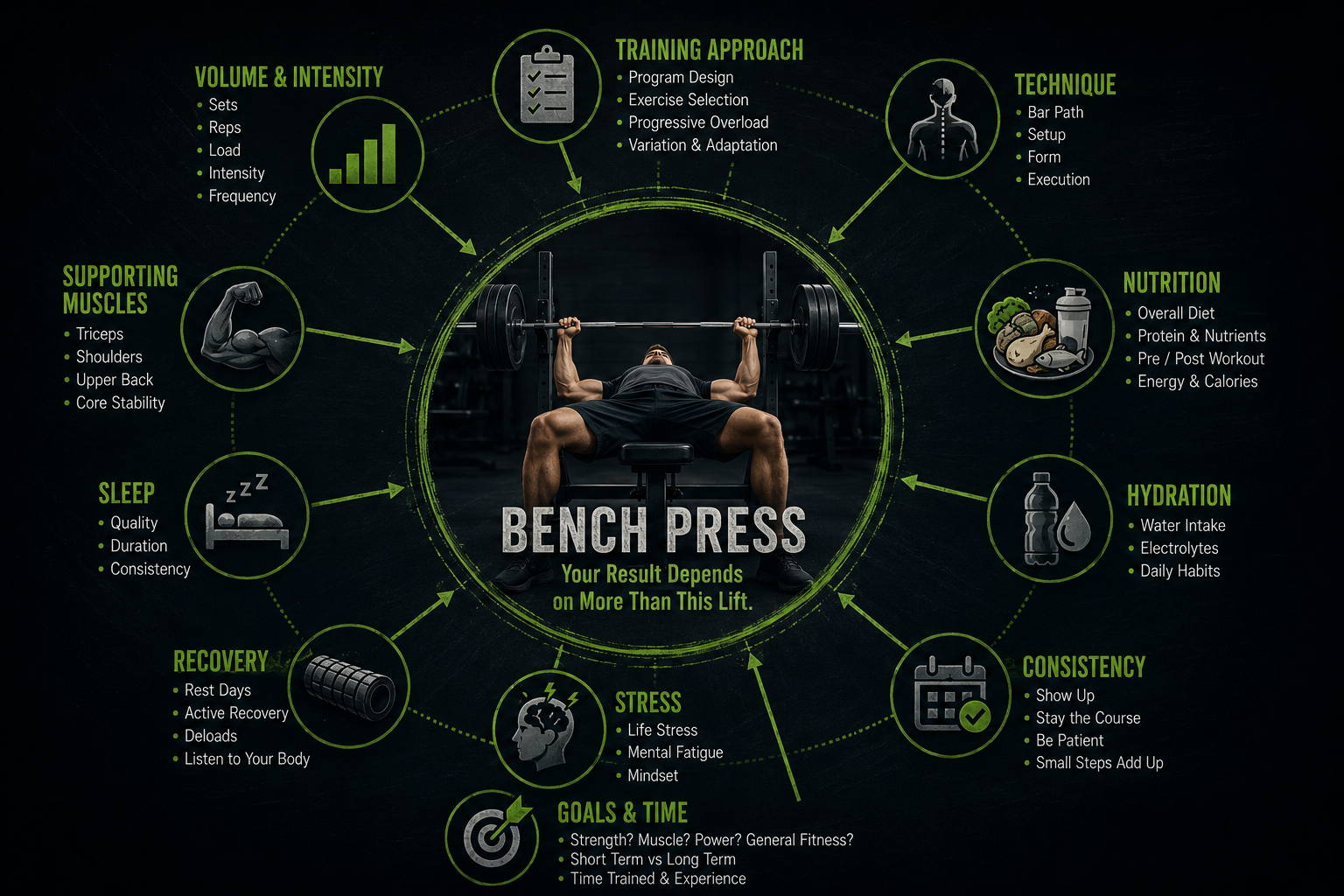
Now we are talking about weight, repetitions, sets, intensity, frequency, rest periods, exercise order, technique, supporting muscle groups, training variation, progressive overload, nutrition, protein, hydration, sleep, recovery, stress, consistency, training history, goals, and time.
There are more things we could add.
And somewhere around here you may reasonably be thinking:
I just wanted to know why my bench press isn't improving. How did we end up talking about what I eat, how I sleep, what I trained yesterday, and what I have been doing for the last six months?
That is the point.
There was never going to be one answer because your bench press is not produced by the bench press alone. It is an outcome of many things happening together.
The difficult part is not creating a list of things that could be affecting your progress.
The difficult part is figuring out which of them actually apply to you.
This Is Why Personal Trainers Exist
A good personal trainer isn't there to just yell or motivate you, to just push you through one to two more repetitions, or to hand you a list of exercises to perform. Their role goes well beyond simply getting you through today's workout.
A qualified trainer has studied training principles, exercise programming, human movement, nutrition, recovery, assessment, and the other factors that influence physical performance. That education is supplemented by practical experience — both their own and what they learn from working with different clients over time.
But perhaps the most important difference between a trainer and an article like this one is much simpler:
Before deciding what you should be doing, a good trainer can assess where you are now. They can ask about your training experience and what you have been doing. They can talk with you about what you are trying to accomplish and help turn a broad ambition into realistic goals with reasonable expectations about how long those goals may take.
Then the training can be built around the person and the goal rather than the other way around.
That matters because someone trying to increase a bench press is not necessarily going to train like someone preparing for a bodybuilding competition. Someone trying to lose weight has different priorities from someone training for a marathon. A person returning to exercise after years away from it is starting from a different place than someone who has been lifting consistently for a decade.
Even two people pursuing the same goal may not respond to the same approach in exactly the same way.
A trainer can help bring all of those pieces together — training, progression, nutrition, recovery, realistic goals, and the circumstances of the person doing the work. Then, as the results come in, the approach can change when it needs to.
That is a very different thing from simply telling someone to bench more.
Back to the Original Question
So, why isn't your bench press improving?
Maybe the answer is buried somewhere in your training. Maybe it is something happening outside the gym. Maybe you need more time. Maybe you actually have been progressing and have been measuring that progress by the wrong thing.
Or maybe several small things need attention at the same time.
This article cannot tell you which one it is.
What it can do is show you the roadmap.
If you understand enough about your own training to follow that map and figure out where you may be going wrong, great. Make an informed change, give it time, and see what happens.
If you cannot figure it out, ask someone you trust who knows more about it than you do.
And if you do not have that person, consider talking with a qualified personal trainer or Certified Personal Trainer. Your local gym or fitness center can probably help you find one, and many trainers now work with clients online as well.
There is nothing particularly mysterious about getting stronger. But there is considerably more involved than simply showing up and moving a weight from one place to another.
Sometimes the most useful thing you can learn is what to change.
And sometimes the most useful thing you can do is find someone who can help you figure that out.